Ever found the perfect recipe only to realize it makes far too much food?
Learning how to halve a recipe makes everyday cooking and baking easier, reduces food waste, and saves money.
These 10 easy recipe conversion charts for halving ingredients will help you adjust measurements, prepare smaller batches, and enjoy homemade meals and desserts without unnecessary leftovers.
1. Printable recipe conversion chart showing common ingredient measurements divided in half, including cups, tablespoons, and teaspoons for everyday cooking and baking.
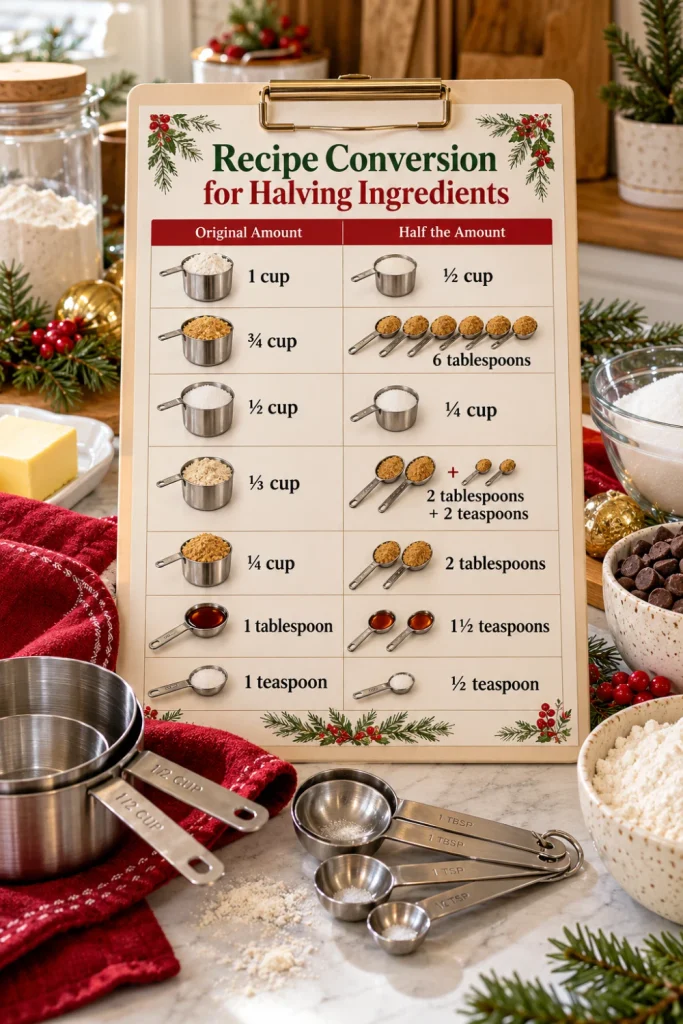
A printable recipe conversion chart makes smaller-batch cooking much simpler.
Keep common measurements nearby, and you won’t need to calculate every ingredient from scratch.
Simple steps:
- Divide each original ingredient measurement by two.
- Use this quick reference for common conversions:
- 1 cup = ½ cup
- ¾ cup = ⅜ cup, or 6 tablespoons
- ½ cup = ¼ cup
- ⅓ cup = 2 tablespoons + 2 teaspoons
- ¼ cup = 2 tablespoons
- 2 tablespoons = 1 tablespoon
- 2 teaspoons = 1 teaspoon
- 1 teaspoon = ½ teaspoon
- Print the chart or save it to your phone for easy access while cooking.
Helpful tip: Keep measuring spoons and cups together so you can move between measurements without interrupting your cooking.
2. Recipe measurement conversion chart showing how to convert common cup fractions into tablespoons when halving ingredients for smaller recipes.
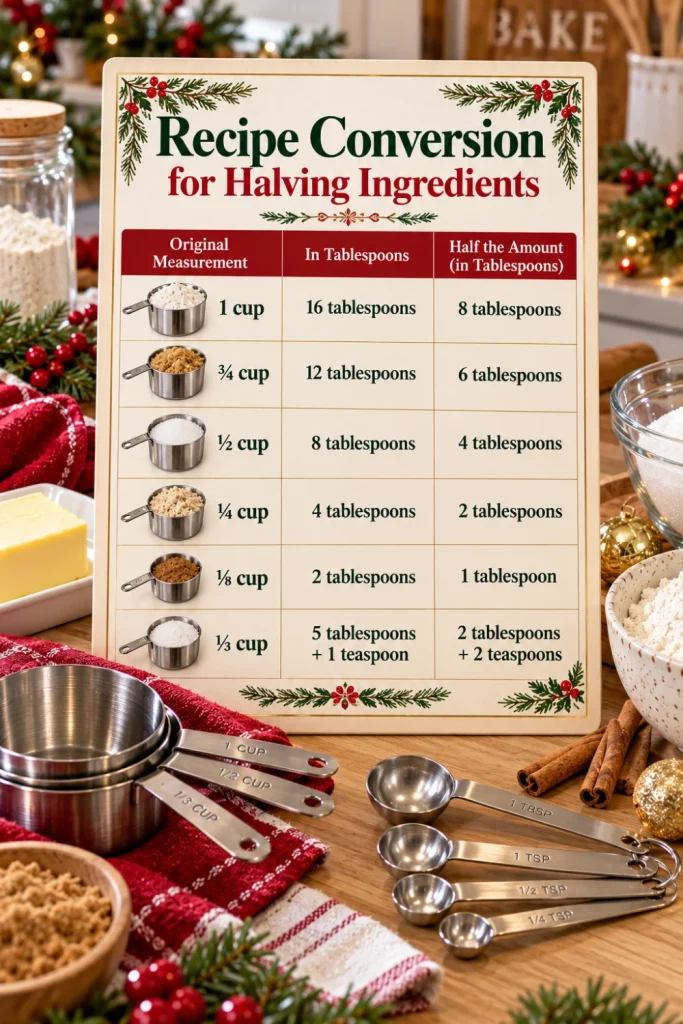
Cup fractions can be awkward when you’re cutting a recipe in half.
Converting cups into tablespoons gives you a practical alternative, particularly when your measuring cup doesn’t include smaller fractions.
Simple steps:
- Remember that 1 cup contains 16 tablespoons.
- Convert the original cup measurement into tablespoons.
- Divide the tablespoon total by two.
Use these examples:
- 1 cup becomes 8 tablespoons.
- ¾ cup becomes 6 tablespoons.
- ½ cup becomes 4 tablespoons.
- ¼ cup becomes 2 tablespoons.
- ⅛ cup becomes 1 tablespoon.
Helpful tip: For ⅓ cup, the exact half is 2 tablespoons plus 2 teaspoons. This is easier than trying to measure an unusual cup fraction.
3. Printable baking recipe halving chart featuring common cup fractions, tablespoon and teaspoon equivalents, and ingredient measurements for smaller batches.
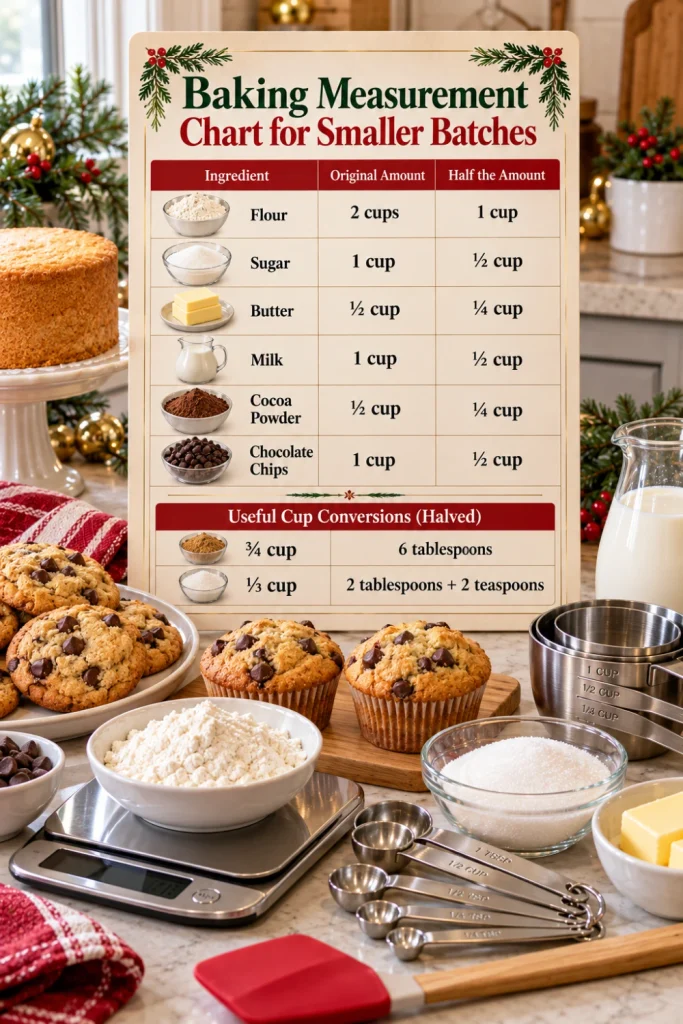
Baking requires more attention to measurements than many everyday meals.
A printable baking recipe halving chart helps you scale down cookies, muffins, brownies, and cakes while keeping ingredient proportions consistent.
Simple steps:
- Write down the original ingredient quantities.
- Halve every ingredient, including flour, sugar, butter, and milk.
- Measure dry ingredients carefully and level off measuring cups.
- Check the baking time earlier than the original recipe suggests.
A few useful examples:
- 2 cups flour → 1 cup flour.
- 1 cup sugar → ½ cup sugar.
- ½ cup butter → ¼ cup butter.
- 1 cup milk → ½ cup milk.
- ½ cup chocolate chips → ¼ cup chocolate chips.
Helpful tip: A smaller batch may finish baking sooner, but the result depends on the pan size and depth. Start checking for doneness before the original recipe’s stated finish time.
4. Recipe conversion chart for smaller portions showing original ingredient amounts and their halved measurements for everyday meals and desserts.
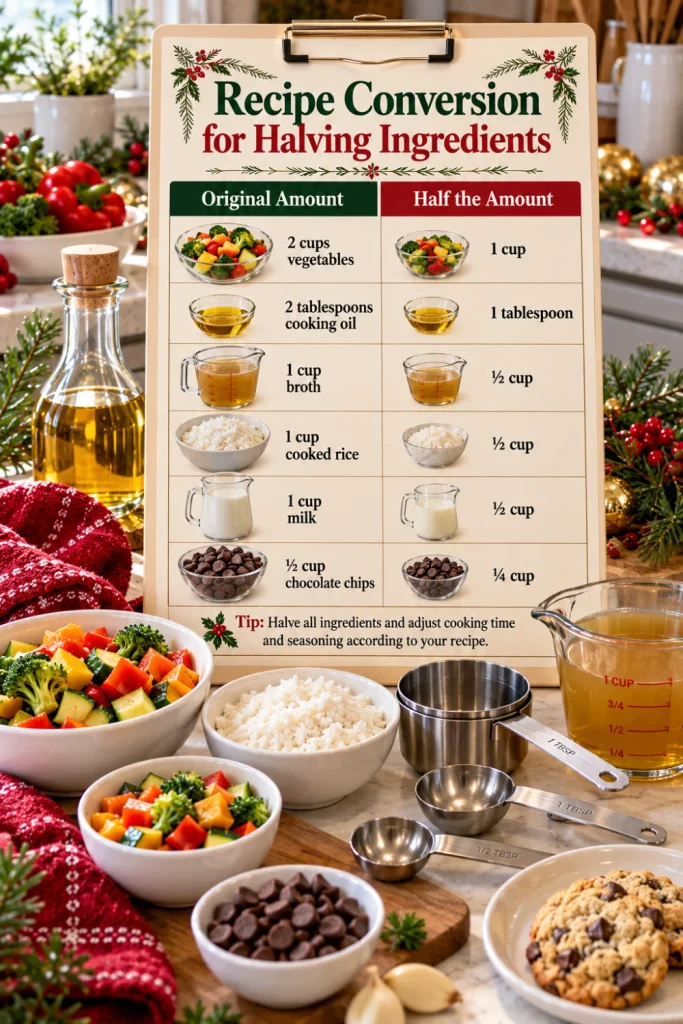
Cooking for fewer people doesn’t mean sacrificing variety.
A recipe conversion chart showing original and halved quantities makes it easier to prepare fresh dinners, sauces, soups, and desserts without filling the refrigerator with leftovers.
Simple steps:
- Identify the number of servings in the original recipe.
- Divide each ingredient by two to make half the quantity.
- Reduce the cooking liquid carefully if the recipe requires simmering.
- Taste and adjust seasonings toward the end.
For example:
- 2 cups cooked rice → approximately 1 cup cooked rice.
- 1 cup chopped vegetables → ½ cup.
- 2 tablespoons cooking oil → 1 tablespoon.
- 1 cup broth → ½ cup.
Helpful tip: Halve the main ingredients first, but treat salt, chilli, and strong spices with care. You can always add more after tasting.
5. Baking measurement chart illustrating how to halve flour, sugar, butter, milk, and other common ingredients for cookies, cakes, and muffins.
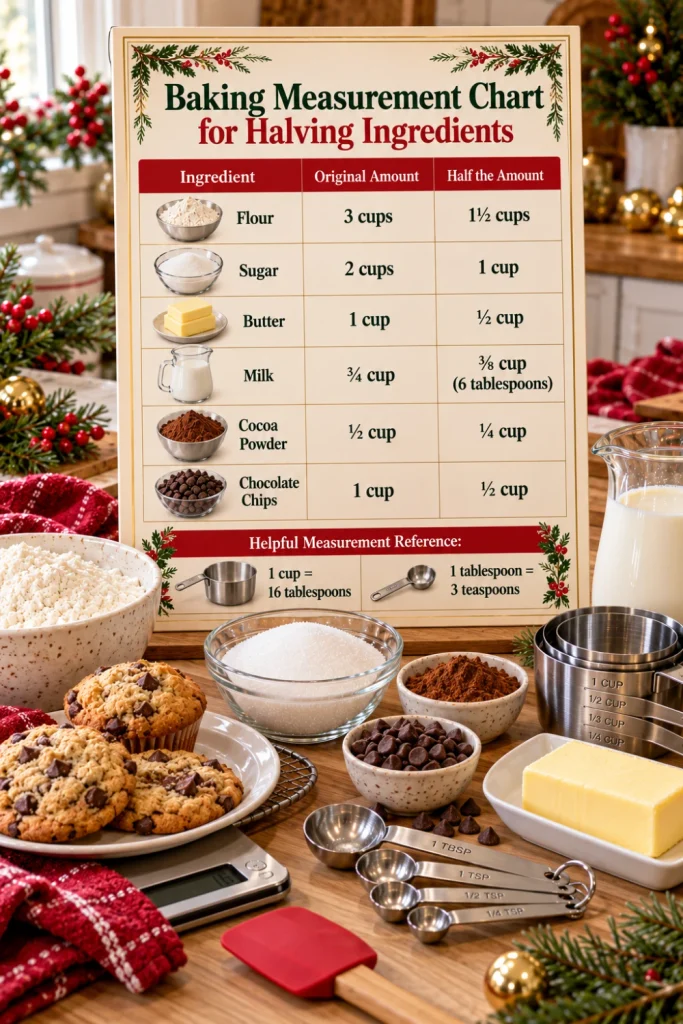
Flour, sugar, butter, and milk form the foundation of many baking recipes.
Knowing their halved measurements makes it easier to prepare a small tray of cookies or a few muffins instead of a full batch.
Simple steps:
- Measure the quantity specified in the original recipe.
- Divide that quantity by two.
- Use the appropriate measuring tool for each ingredient.
Here’s a quick ingredient chart:
| Original amount | Half the amount |
|---|---|
| 3 cups flour | 1½ cups |
| 2 cups sugar | 1 cup |
| 1 cup butter | ½ cup |
| ¾ cup milk | ⅜ cup, or 6 tablespoons |
| ½ cup cocoa powder | ¼ cup |
| 1 cup chocolate chips | ½ cup |
Helpful tip: Butter sticks and packaged blocks may show measurement markings. If not, use a kitchen scale when available for more consistent results, especially when baking.
6. Recipe halving chart for cooks without a kitchen scale, showing common cup, tablespoon, and teaspoon conversions for smaller batches.
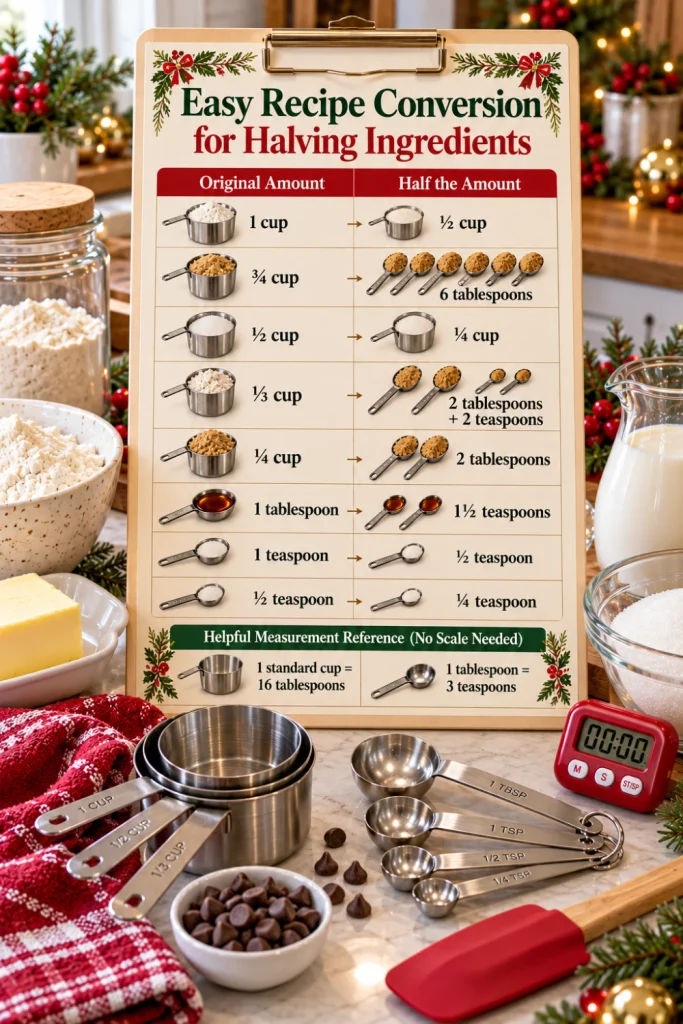
A kitchen scale is useful, but it isn’t essential for every home recipe.
With standard measuring cups and spoons, you can still scale down many everyday dishes and simple baking recipes.
Simple steps:
- Check whether your recipe uses cups, tablespoons, teaspoons, or weight.
- Keep the original unit when dividing by two.
- Convert to smaller spoon measurements when needed.
- Level dry ingredients rather than packing them into measuring cups unless the recipe specifically says otherwise.
Try these conversions:
- 1 tablespoon → 1½ teaspoons.
- 1 tablespoon → ½ tablespoon when halved, equivalent to 1½ teaspoons.
- 1 teaspoon → ½ teaspoon.
- ½ teaspoon → ¼ teaspoon.
- ¼ teaspoon → ⅛ teaspoon.
Helpful tip: Standard measuring spoons are more reliable than ordinary eating spoons, which vary in size. For flour-heavy baking, weighing ingredients is often the most consistent approach.
7. Ingredient measurement chart showing halved amounts of flour, sugar, butter, and milk for home cooking and baking recipes.
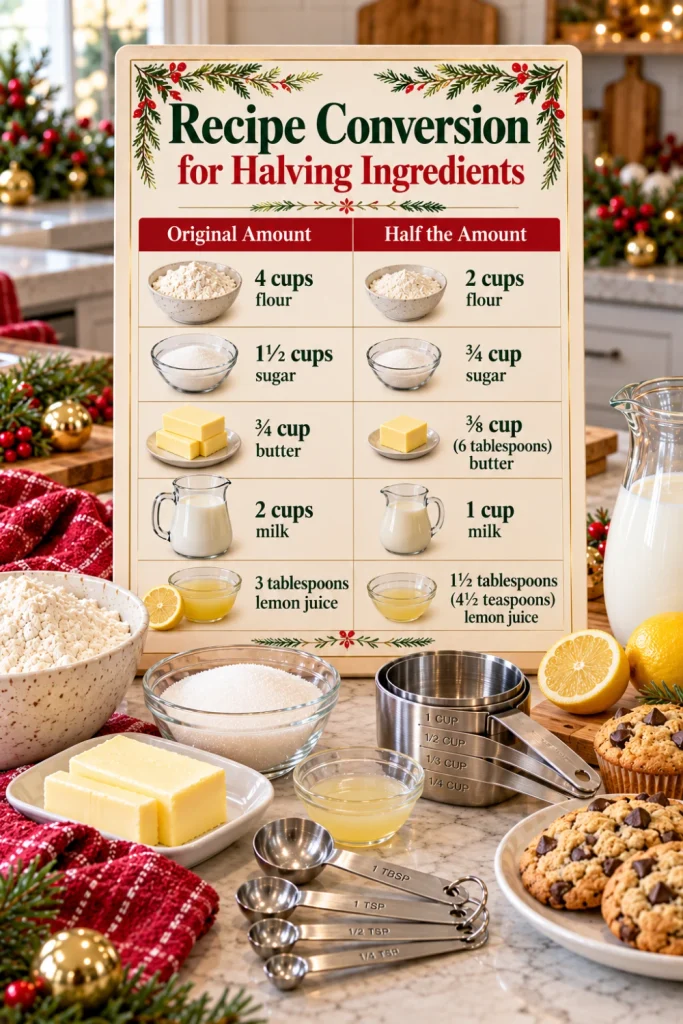
Different ingredients behave differently in a recipe, but their quantities can usually be halved mathematically.
A simple ingredient measurement chart helps you prepare smaller portions without repeatedly reaching for a calculator.
Simple steps:
- Make a list of all the ingredients.
- Write the original measurement beside each one.
- Divide each amount by two.
- Check the adjusted list before mixing or cooking.
Common examples include:
- 4 cups flour → 2 cups.
- 1½ cups sugar → ¾ cup.
- ¾ cup butter → ⅜ cup, or 6 tablespoons.
- 2 cups milk → 1 cup.
- 3 tablespoons lemon juice → 1½ tablespoons, or 4½ teaspoons.
Helpful tip: If a recipe calls for half an egg, beat one egg thoroughly and measure out half by weight or volume. This helps prevent uneven distribution of egg white and yolk.
8. Small-batch recipe scaling chart with common ingredient conversions for preparing smaller quantities of meals, cookies, cakes, and desserts.
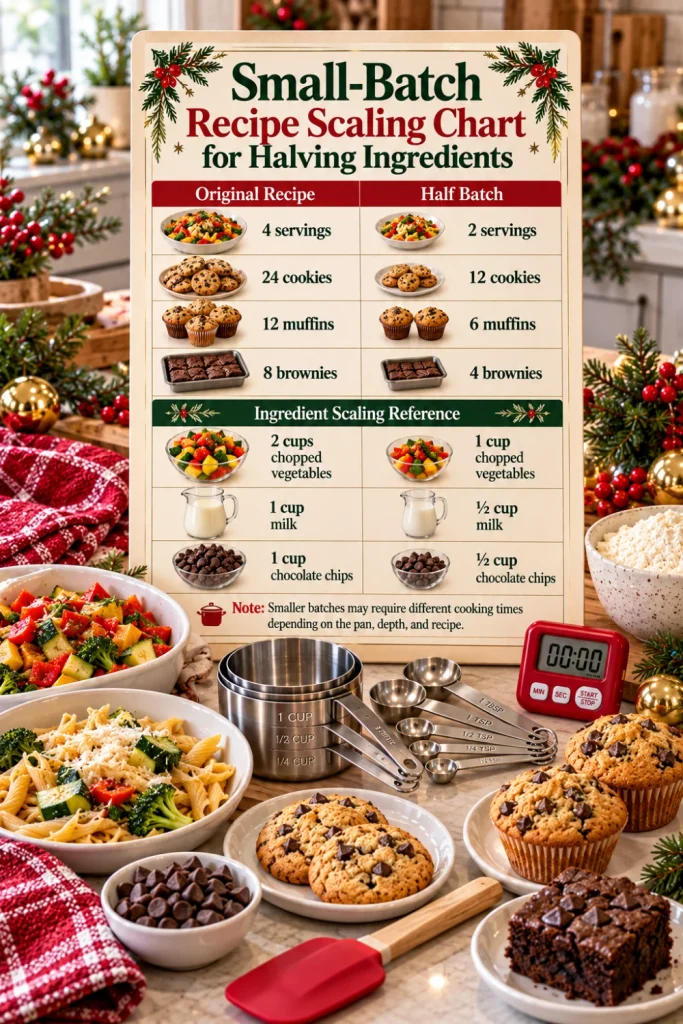
Small-batch cooking is useful for quick weeknight dinners, after-school treats, and desserts for two.
A recipe scaling chart helps you reduce quantities while keeping your ingredient ratios balanced.
Simple steps:
- Decide how much food you actually need.
- For half a recipe, multiply each ingredient by 0.5.
- For a quarter recipe, multiply each ingredient by 0.25.
- Adjust cooking equipment and check doneness as the food cooks.
For example:
- 4 servings of pasta → 2 servings.
- 24 cookies → approximately 12 cookies.
- 12 muffins → approximately 6 muffins.
- 8 brownies → approximately 4 brownies.
Helpful tip: Smaller quantities don’t always mean exactly half the cooking time. Use visual cues, a food thermometer where appropriate, or a recipe’s recommended doneness tests rather than relying only on the clock.
9. Beginner-friendly recipe halving cheat sheet with simple cup fractions, tablespoon conversions, teaspoon measurements, and kitchen scaling tips.
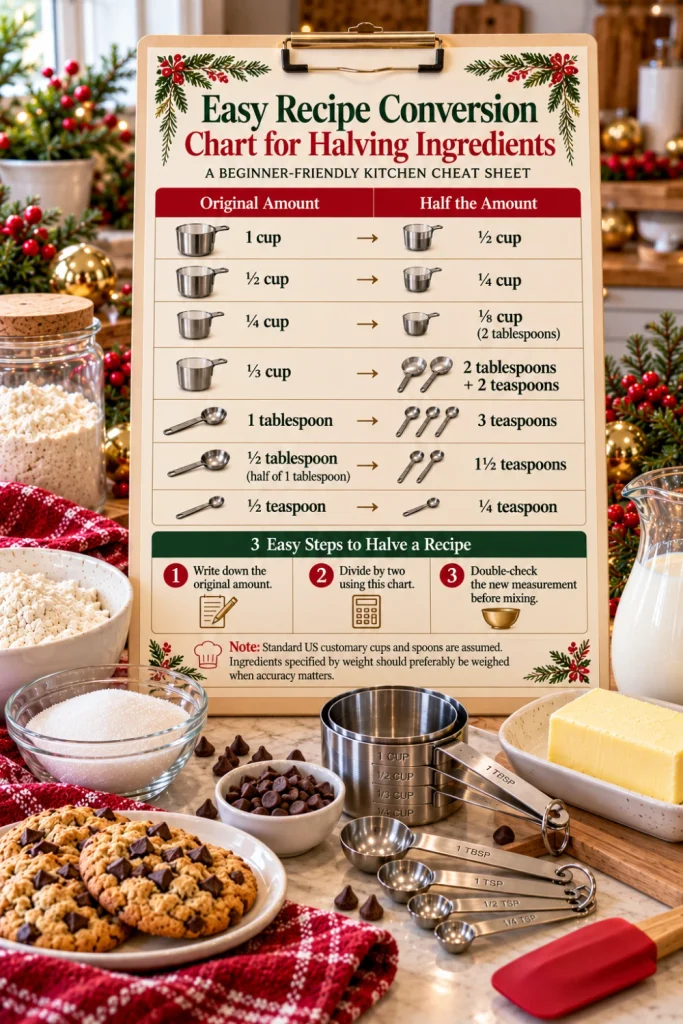
New cooks can make recipe adjustments confidently with a beginner-friendly cheat sheet.
The trick is to learn a few common conversions first instead of memorizing every possible measurement.
Simple steps:
- Start with familiar measurements such as 1 cup, ½ cup, and ¼ cup.
- Memorize that 1 cup equals 16 tablespoons and 1 tablespoon equals 3 teaspoons.
- Halve the quantity before converting it into another unit.
- Double-check unusual fractions before adding ingredients.
Keep these quick reminders handy:
- Half of 1 cup = ½ cup.
- Half of ½ cup = ¼ cup.
- Half of ¼ cup = ⅛ cup, or 2 tablespoons.
- Half of ⅓ cup = 2 tablespoons + 2 teaspoons.
- Half of 1 tablespoon = 1½ teaspoons.
Helpful tip: Write the new measurement beside the original recipe rather than trying to remember it while cooking. This small habit can prevent mistakes, especially when several ingredients need adjusting.
10. Recipe conversion chart for cooking for two, showing how to halve common ingredient measurements for smaller dinners and homemade desserts.
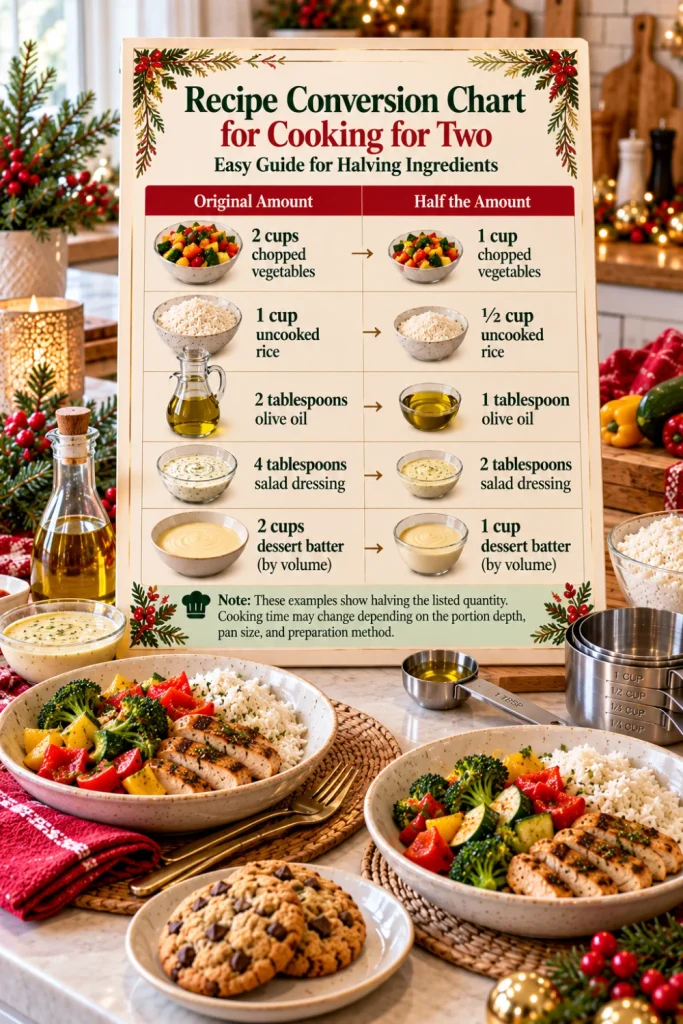
Easy Recipe Conversion Chart for Halving Ingredients for cooking for two, showing smaller measurements for vegetables, rice, olive oil, salad dressing, and desserts with modern kitchen cutlery and festive Christmas table styling.
Cooking for two is easier when recipes are adjusted before preparation begins.
A conversion chart helps you plan balanced dinners, fresh side dishes, and homemade desserts without automatically making four or six servings.
Simple steps:
- Check the original serving size.
- Divide every ingredient by two if the recipe serves four.
- Use smaller pans or baking dishes where appropriate.
- Refrigerate leftovers promptly and store them in suitable containers.
For a dinner serving two, consider these examples:
- 2 cups chopped vegetables → 1 cup.
- 1 cup uncooked rice → ½ cup.
- 2 tablespoons olive oil → 1 tablespoon.
- 4 tablespoons dressing → 2 tablespoons.
- 2 cups dessert batter, measured by volume → approximately 1 cup, if the batter can be measured reliably.
Helpful tip: Recipes for two can still benefit from meal planning. Prepare versatile ingredients, such as roasted vegetables or cooked grains, that can be used in another meal without making the same dinner twice.
Final Thoughts
A reliable recipe conversion chart for halving ingredients can make home cooking less wasteful, more flexible, and easier to manage.
Whether you’re preparing a quick dinner, baking a small batch of cookies, or making dessert for two, the key is to adjust every ingredient carefully and understand when cooking methods need additional attention.
Before you start your next recipe, keep these practical reminders nearby:
- Halve every ingredient: Include seasonings, liquids, toppings, and cooking fats.
- Use accurate measurements: Standard measuring cups and spoons work well, while a kitchen scale is especially helpful for baking.
- Handle eggs carefully: Beat the egg first when you need only part of it.
- Check cooking times: Smaller portions may cook faster, but pan size and food thickness matter.
- Keep a printable reference: Save your favorite conversion chart on your phone or print it for your kitchen.
- Record successful adjustments: Note changes to pan sizes, cooking times, and ingredient quantities so you can repeat the recipe.
For even more useful kitchen planning, explore related resources such as a cups-to-tablespoons conversion chart, a baking measurement cheat sheet, a recipe scaling calculator, and a small-batch dessert guide.
These references can help you move beyond halving recipes to adjusting portions for different household sizes.
The best approach is simple: measure carefully, make sensible adjustments, and check your results as you cook.
With these 10 easy recipe conversion chart ideas, preparing smaller meals and baking batches becomes a practical everyday skill rather than another kitchen calculation to worry about.